Presented at Frieze Masters 2025, Rediscovered showcases some of the most significant ancient artworks to resurface in recent years, shedding light on their hidden histories and reconnecting them to their origins. From a rare Egyptian quartzite relief once coveted by Belle da Costa Greene, the pioneering library director for J. P. Morgan, to the only …

Presented at Frieze Masters 2025, Rediscovered showcases some of the most significant ancient artworks to resurface in recent years, shedding light on their hidden histories and reconnecting them to their origins. From a rare Egyptian quartzite relief once coveted by Belle da Costa Greene, the pioneering library director for J. P. Morgan, to the only complete surviving bust of Marcus Aurelius Fulvus Antoninus, each piece has been rediscovered after being misattributed, obscured, or hidden in private collections for centuries.
A Rare Egyptian Quartzite Relief
Among the most exceptional pieces is a rare Egyptian quartzite relief, dating to the early Ptolemaic period, circa 332 BC. Carved from a luminous quartzite stone once quarried near the cult center of the sun god Ra, this material was among the most prized by the ancient Egyptians. Originally hidden beneath layers of black varnish, the relief resurfaced at a Paris auction last year, where it was misattributed and its provenance incomplete. Through detailed research, ArtAncient traced the piece back to the celebrated 1914 sale of the Arthur Sambon Collection, one of the most distinguished ancient art collections of its time.
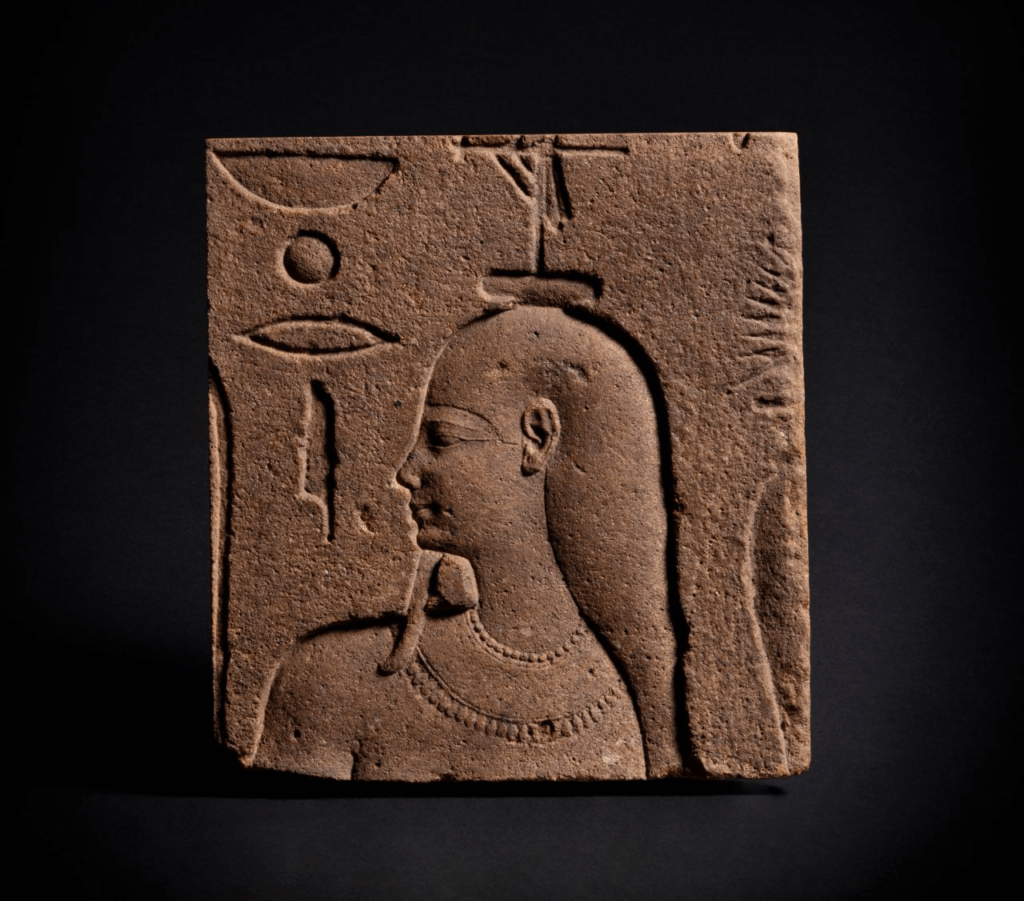
Further investigation uncovered a fascinating connection to Belle da Costa Greene, the confidante of J. P. Morgan. In a private letter to Bernard Berenson, Greene revealed her desire to own the very piece, saying, “I should love to have [the] Egyptian plaque…”. This personal correspondence adds a layer of intrigue to the piece’s provenance and reveals its significance to one of the early 20th century’s most influential tastemakers.
The Bust of Marcus Aurelius Fulvus Antoninus
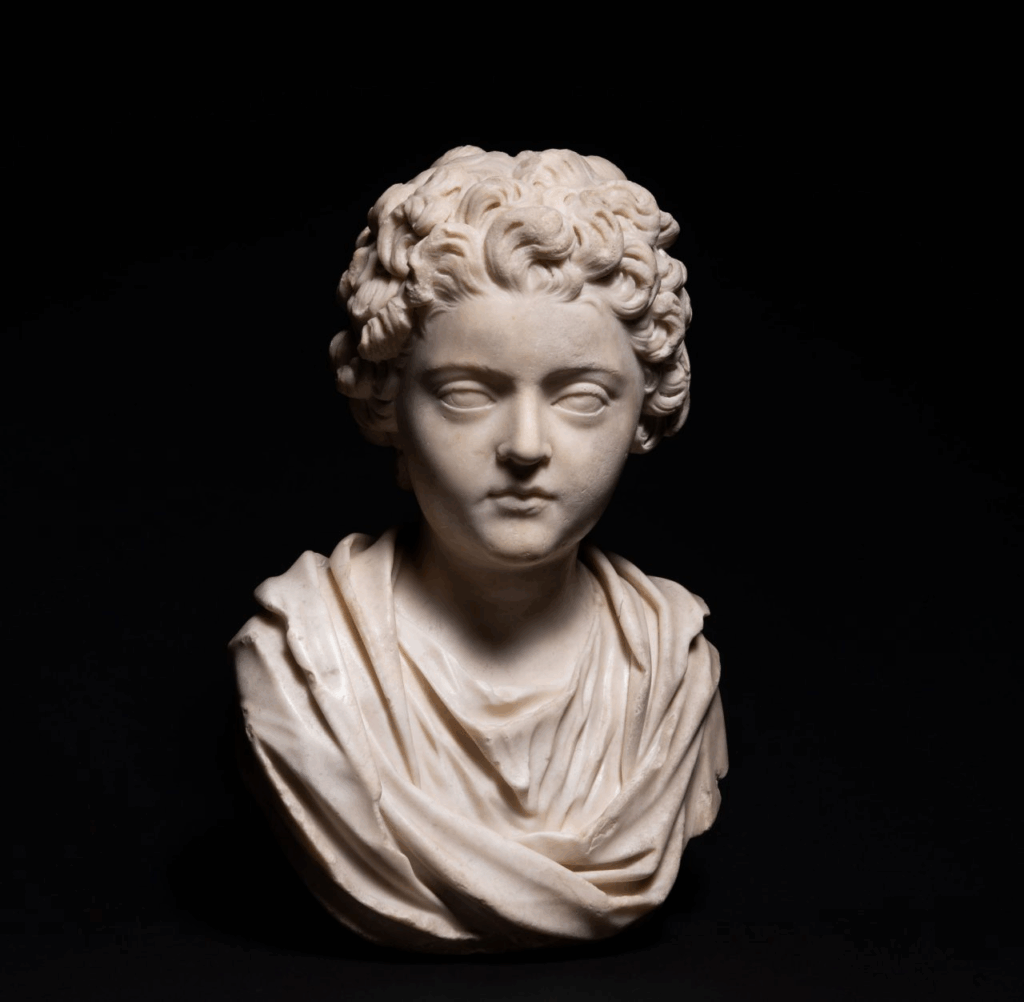
Another centerpiece of Rediscovered is a marble bust of Marcus Aurelius Fulvus Antoninus, the son of Antoninus Pius. Dated to around 140 AD, this portrait was long believed to be a 19th-century replica. However, after being rediscovered at a provincial auction last year, scientific analysis and comparisons with fragmentary portraits confirmed its authenticity. It is now regarded as the only complete surviving likeness of Marcus Aurelius Fulvus Antoninus, offering a unique glimpse into Roman imperial portraiture. This rare piece will be unveiled at Frieze Masters as one of the most significant imperial portraits still in private hands.
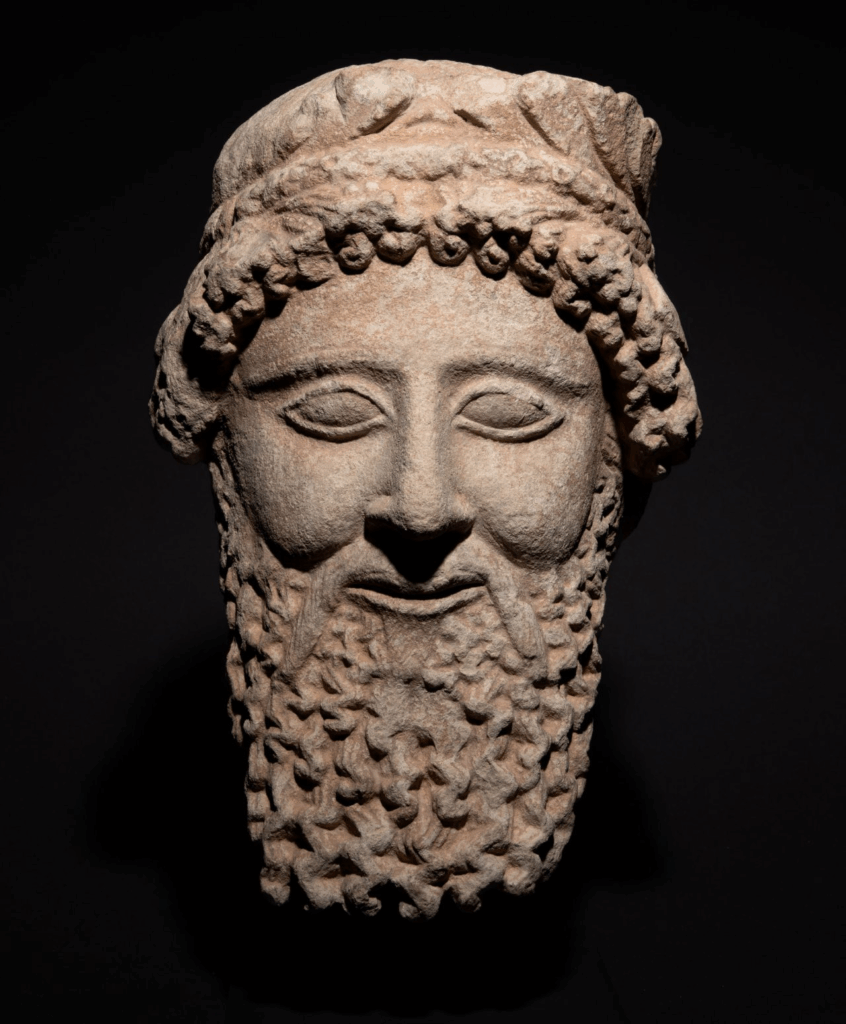
Archaic Cyprus Limestone Head
A monumental limestone head from Archaic Cyprus, dating to the 6th–5th century BC, is another exceptional rediscovery. Unearthed from the temple of Aphrodite at Golgoi by Luigi Palma di Cesnola, the sculpture was originally part of the founding collection of the Metropolitan Museum of Art in New York before being deaccessioned in 1928. After passing through an English private collection, its distinguished history was forgotten. ArtAncient has now restored its archaeological pedigree, presenting it as one of the few surviving masterworks from the foremost sanctuary of Archaic Cypriot art, and among the most significant works still in private hands.
Baboon Figure from Egypt’s Late Period
A finely modelled figure of a baboon, carved in wood and embellished with a bronze face and electrum, calcite, and glass inlays, is another remarkable rediscovery. Dating to Egypt’s Late Period, circa 664–332 BC, the figure was misdescribed and lacked provenance when it appeared at a small U.S. auction. ArtAncient has traced the piece to Tuna el-Gebel, the cult center of Thoth, the god of wisdom, where baboons were revered as his living manifestations. This piece may have once stood in a temple as an offering or a protective emblem, embodying the mysteries of knowledge and the sun.
Granite Torso of Egyptian Official Hor-maa-kheru
Another important rediscovery is the granite torso of the Egyptian official Hor-maa-kheru, dating to around 285–186 BC. This finely modelled Ptolemaic figure from Mendes features hieroglyphic inscriptions that name Hor-maa-kheru and list his priestly and civic titles, highlighting his high status within the elite. During conservation, a hidden label was uncovered beneath the felt pad of the wooden base, revealing that the torso had once been exhibited in the Spaeth Collection at the Columbus Gallery of Fine Arts in Ohio, alongside works by Picasso, Gauguin, Chagall, and Cézanne.
Rediscovered: A Celebration of Lost Histories
“Every one of these works embodies the spirit of rediscovery,” said Jethro Sverdloff, Director of ArtAncient. “Our mission is not only to present objects of exceptional beauty, but also to recover their lost histories, reconnecting them to their archaeological origins and the distinguished collections they once adorned. Rediscovered is a celebration of this process, and we are proud to share these remarkable stories at Frieze Masters 2025.”
Sverdloff emphasized, “Rediscovered isn’t just about the objects. It’s about the dramatic ways in which fate shaped their fortunes, and the human stories of the collectors, scholars, and eccentric personalities who crossed their paths.”
Frieze Masters 2025
Presented by ArtAncient, a leading London-based gallery specializing in ancient art, fossils, meteorites, and early sculpture, Rediscovered will be on view at Frieze Masters 2025, which runs from October 15th to 19th at Regent’s Park, London.
For more information, visit ArtAncient.com and explore their rigorous research and uncompromising quality in ancient art.
This Frieze Masters 2025 exhibition offers an extraordinary opportunity to witness the unveiling of some of the most significant rediscovered masterpieces in ancient art, reconnecting these objects to their lost histories and rightful places in the art world.