The National Army Museum, Chelsea has announced a major new long-term exhibition, Myth and Reality: Military Art in the Age of Queen Victoria. Opening in 2025, the exhibition brings together over 140 works of art to explore how Victorian artists shaped public attitudes to the Army and the lived experiences of soldiers on the frontline. …

The National Army Museum, Chelsea has announced a major new long-term exhibition, Myth and Reality: Military Art in the Age of Queen Victoria. Opening in 2025, the exhibition brings together over 140 works of art to explore how Victorian artists shaped public attitudes to the Army and the lived experiences of soldiers on the frontline.
This is the Museum’s first dedicated art exhibition in over five years, and it draws on its extensive collection alongside significant loans from the Royal Collection and the National Portrait Gallery.
Victorian Art and the Army
During Queen Victoria’s reign, artists and illustrators profoundly influenced how the public perceived Britain’s Army. Their works ranged from heroic battle scenes and royal commissions to intimate sketches by soldiers themselves. Prints and reproductions spread these images across middle-class homes, ensuring the Army’s campaigns were a visible part of domestic life.
The exhibition is arranged across four themes:
- The Female Perspective
- The Great Campaigns
- Patriotism and Portraiture
- Realism and Reportage
Lady Butler – A Woman at the Forefront of Military Painting
One of the exhibition’s focal points is the work of Elizabeth Thompson, Lady Butler, the most celebrated military painter of her age. Butler rose to fame with The Roll Call (1874), depicting exhausted soldiers returning from battle, which caused a sensation at the Royal Academy Summer Exhibition.
Highlights include:
- The Dawn of Waterloo (1895), acquired by the Museum in 2021 with Art Fund support
- The Roll Call (1874), on loan from His Majesty The King
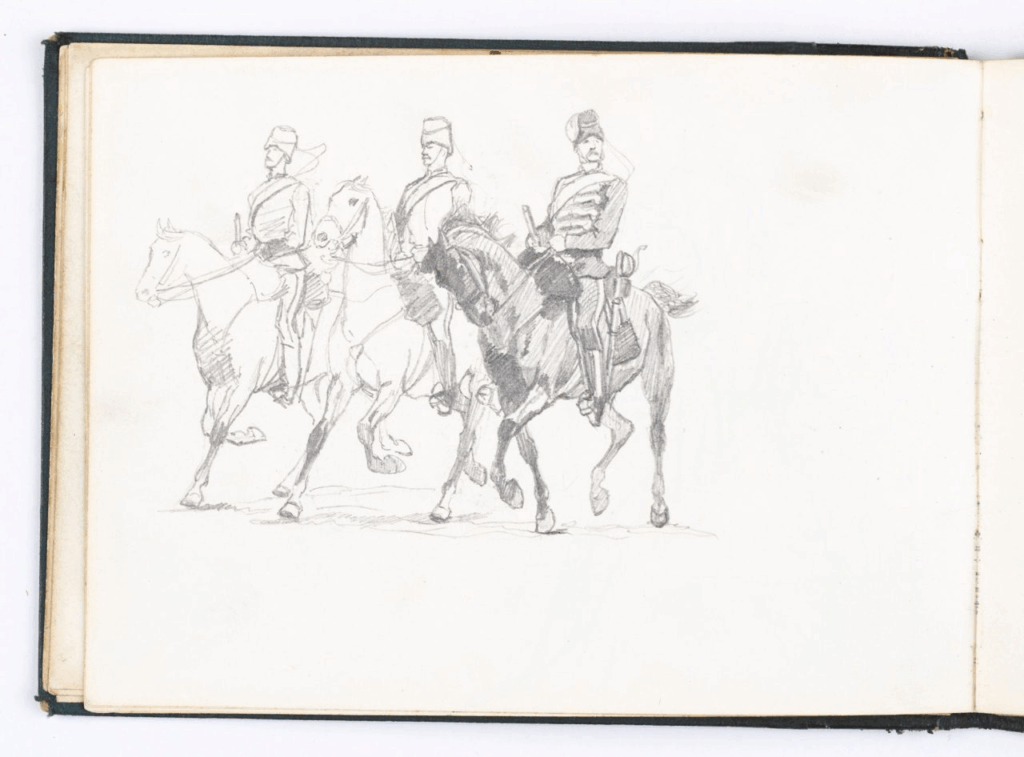
- Lady Butler’s personal sketchbooks, displayed for the first time
Her meticulous approach—buying uniforms, consulting soldiers, and studying battle accounts—made her paintings synonymous with Victorian military identity.
Queen Victoria and the Female Perspective
Women, too, became central figures in Victorian military art. The exhibition includes depictions of Florence Nightingale, celebrated for her pioneering work in military hospitals during the Crimean War.
It also explores Queen Victoria’s role as Commander in Chief, with paintings such as Her Majesty Queen Victoria Inspecting the Wounded Guards (1856) by Simeon A Beeger.
Campaigns Across the Empire
The Victorian Army fought annual campaigns across Africa, India, and beyond during Queen Victoria’s reign. Artists both glorified and critiqued these encounters.
Highlights include:
- The Capitulation of Kars, Crimean War (1855) by Thomas Jones Barker – a five-metre-wide canvas shown for the first time since 2003. Despite depicting a British defeat, it was widely reproduced to boost patriotic morale.
- Works by war artists including William Simpson, Joseph Arthur Crowe, Edward Matthew Hale, Georges Bertin Scott, and Edmund Walker.
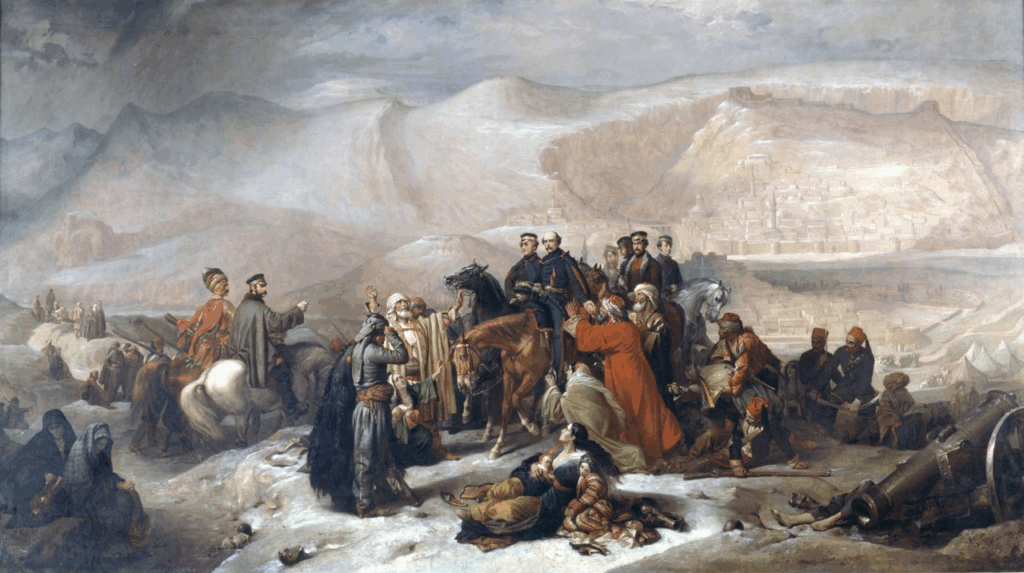
Oil on canvas, National Army Museum
Patriotism and Heroism
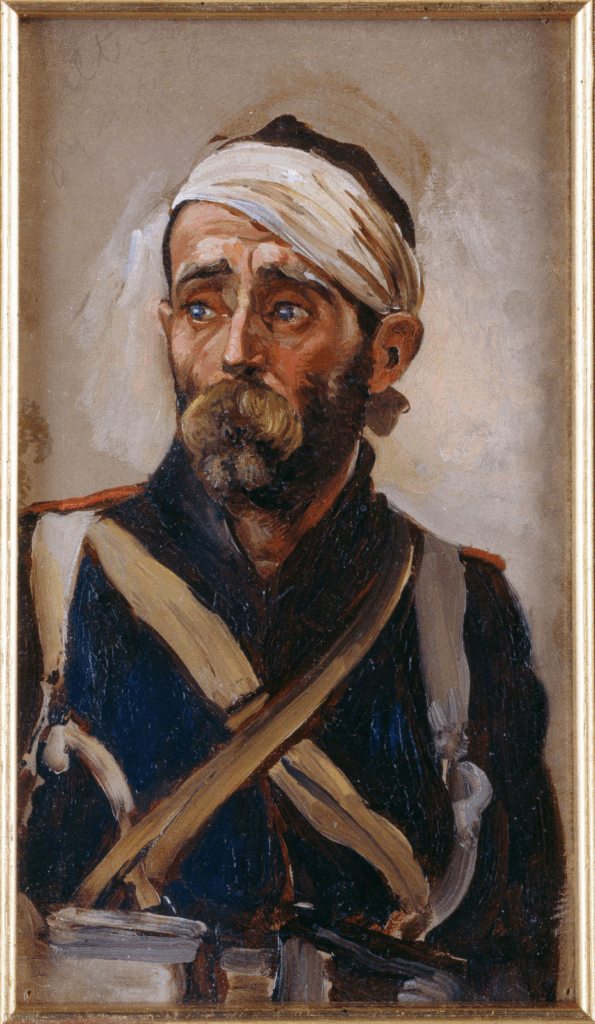
The introduction of the Victoria Cross in 1856 gave rise to portraits of decorated soldiers. Paintings of heroes like Field Marshal Earl Roberts and his son Frederick Hugh Sherston Roberts—one of only three father-son VC pairs—reflected society’s appetite for tales of gallantry.
Meanwhile, military celebrities such as the Duke of Wellington continued to dominate Victorian imagination, with artists presenting him as a near-mythical figure long after Waterloo.
Realism, Reportage, and the Rise of War Correspondents
The Crimean War marked the first time rapid reporting and imagery directly shaped public opinion while the conflict was ongoing. Artists and journalists became eyewitnesses, sending home vivid depictions of the battlefield.
Some works offered documentary realism, challenging romanticised visions of war and influencing later Army reforms. Others blurred the line with propaganda, glorifying controversial campaigns in what might now be considered early forms of “fake news.”
Curators’ Perspectives
Susan Ward, Head of Art at the National Army Museum, commented:
“This is the first time the Museum has brought together artworks from the Victorian era in their own dedicated display. These images are not only powerful, but they shaped how British people thought about the Army and its soldiers for many years to come.”
Brigadier (Retired) Justin Maciejewski, Director of the National Army Museum, added:
“This was a time when the ordinary soldier’s experiences were highlighted as never before. The legacy of these artworks is still evident today.”
Exhibition Details
📍 National Army Museum, Chelsea, London
📅 Long-term exhibition, rotating display every six months
🎟 Free entry (check website for updates)
🌐 www.nam.ac.uk
The exhibition is kindly supported by The Cadogan Charity.