Walking into the Faces and Facets: Satyajit Ray in Colour exhibition at DAG felt less like entering an art gallery and more like stepping into the quiet mind of Satyajit Ray himself. The exhibition, built around the rare colour photographs of photographer Nemai Ghosh, captures Ray not as a distant cinematic giant but as a …
In the Shadow of Satyajit Ray, Modern Indian Cinema Feels Hollow
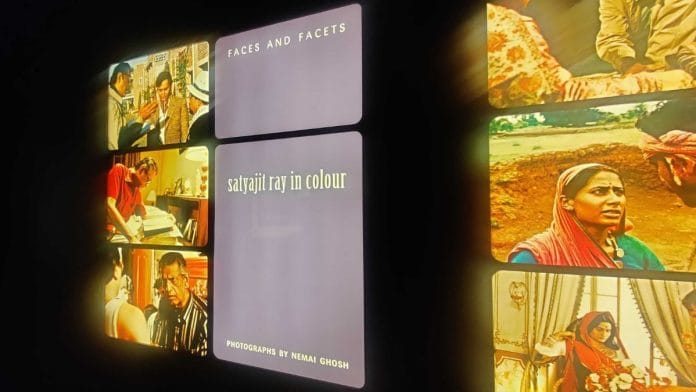
Walking into the Faces and Facets: Satyajit Ray in Colour exhibition at DAG felt less like entering an art gallery and more like stepping into the quiet mind of Satyajit Ray himself. The exhibition, built around the rare colour photographs of photographer Nemai Ghosh, captures Ray not as a distant cinematic giant but as a deeply observant human being immersed in thought, creation, and emotion.
Most of us have grown up seeing Ray in black and white. Those monochrome images turned him into an almost mythical figure of Indian cinema. But this exhibition changes that perception entirely. Through colour, the audience sees the warmth of his home, the clutter of his workspaces, the exhaustion on film sets, and the tenderness in his interactions with actors and collaborators. Suddenly, Ray no longer belongs only to textbooks and film studies classrooms. He becomes startlingly alive.
What makes the exhibition emotionally overwhelming is how intimate it feels. There are moments when Ray sketches, directs scenes, quietly smokes between takes, laughs with his wife Bijoya Ray, or simply observes the world around him. Nemai Ghosh’s lens does not worship Ray from a distance. Instead, it follows him with affection and patience. The photographs reveal the labour behind genius.
The exhibition also reminds visitors that Ray was much more than a filmmaker. He was a writer, illustrator, music composer, typographer, editor, and storyteller. That multidisciplinary brilliance is something Indian cinema rarely produces today. Modern mainstream filmmaking often feels trapped by algorithms, box-office anxieties, and political validation. Ray’s cinema, on the other hand, trusted silence, ambiguity, and emotional intelligence.
One of the strongest reflections the exhibition leaves behind is Ray’s lifelong relationship with the works of Rabindranath Tagore. Ray did not merely adapt Tagore’s stories for cinema. He translated Tagore’s emotional and philosophical depth into visual language. Films like Charulata, adapted from Nashtanirh, captured loneliness and intellectual longing with extraordinary sensitivity. Ghare Baire explored nationalism, gender, and political manipulation in ways that still feel painfully relevant today. Even Teen Kanya carried Tagore’s understanding of fragile human relationships into cinema with quiet grace.
What distinguished Ray’s adaptations was restraint. He never screamed his politics at the audience. He trusted viewers enough to think for themselves. Watching this exhibition in 2026 feels bittersweet because contemporary Indian cinema increasingly seems to lack that trust. Many recent propaganda-driven films reduce storytelling to loud nationalism, simplistic morality, and manufactured patriotism. Characters become mouthpieces instead of people. History becomes selective theatre. Cinema becomes less interested in truth and more interested in applause.
Ray’s films stood in complete opposition to that approach. He questioned power without turning cinema into slogans. He portrayed ordinary people with dignity rather than using them as symbols. Even when discussing politics, religion, or nationalism, his stories remained deeply human. That humanism is exactly what feels absent in many commercially celebrated films today.
The exhibition quietly exposes this gap without explicitly saying it. A single photograph of Ray intensely focused behind the camera says more about artistic sincerity than many modern films with massive budgets and endless patriotic speeches. His cinema believed that empathy itself was political.
There is also something profoundly moving about seeing younger audiences at the exhibition. Many visitors may not have watched every Ray film, yet they stand before these photographs with curiosity and admiration. Perhaps that is Ray’s real legacy. Not nostalgia, but relevance. In an age dominated by noise, outrage, and propaganda, his work still asks us to slow down and look carefully at people.
Faces and Facets is not simply an exhibition about a filmmaker. It is a reminder of what Indian cinema once aspired to be and what it still has the potential to become again.