This autumn, Tate Britain will stage the UK’s largest retrospective of photographer Lee Miller, bringing together around 230 vintage and modern prints, alongside unseen archival material, journals, and ephemera. Running from 2 October 2025 to 15 February 2026, the exhibition spans Miller’s extraordinary career — from surrealist experiments in Paris to her fearless war reportage …

This autumn, Tate Britain will stage the UK’s largest retrospective of photographer Lee Miller, bringing together around 230 vintage and modern prints, alongside unseen archival material, journals, and ephemera. Running from 2 October 2025 to 15 February 2026, the exhibition spans Miller’s extraordinary career — from surrealist experiments in Paris to her fearless war reportage — and explores how she reshaped photography in the 20th century.
From Model to Surrealist Photographer
Born in 1907 in Poughkeepsie, New York, Lee Miller first trained in painting and stage design before a career in modelling introduced her to photography. By 1929, she had moved to Paris, working with Man Ray in a period of creative experimentation that saw them co-discover the solarisation process. Works such as Sirène (Nimet Eloui Bey) (c.1930–32) exemplify her technical innovation.
Miller also apprenticed at French Vogue, ran her own studio, and appeared in Jean Cocteau’s avant-garde film Le Sang d’un poète (1930), extracts of which will be shown at Tate.
The Surreal in Everyday Life
By the early 1930s, Miller was embedded in Paris’s avant-garde, capturing the surreal in the everyday with unconventional angles, reflections, and crops. Returning to New York in 1932, she opened Lee Miller Studios Inc., staging her first solo exhibition and exhibiting internationally.
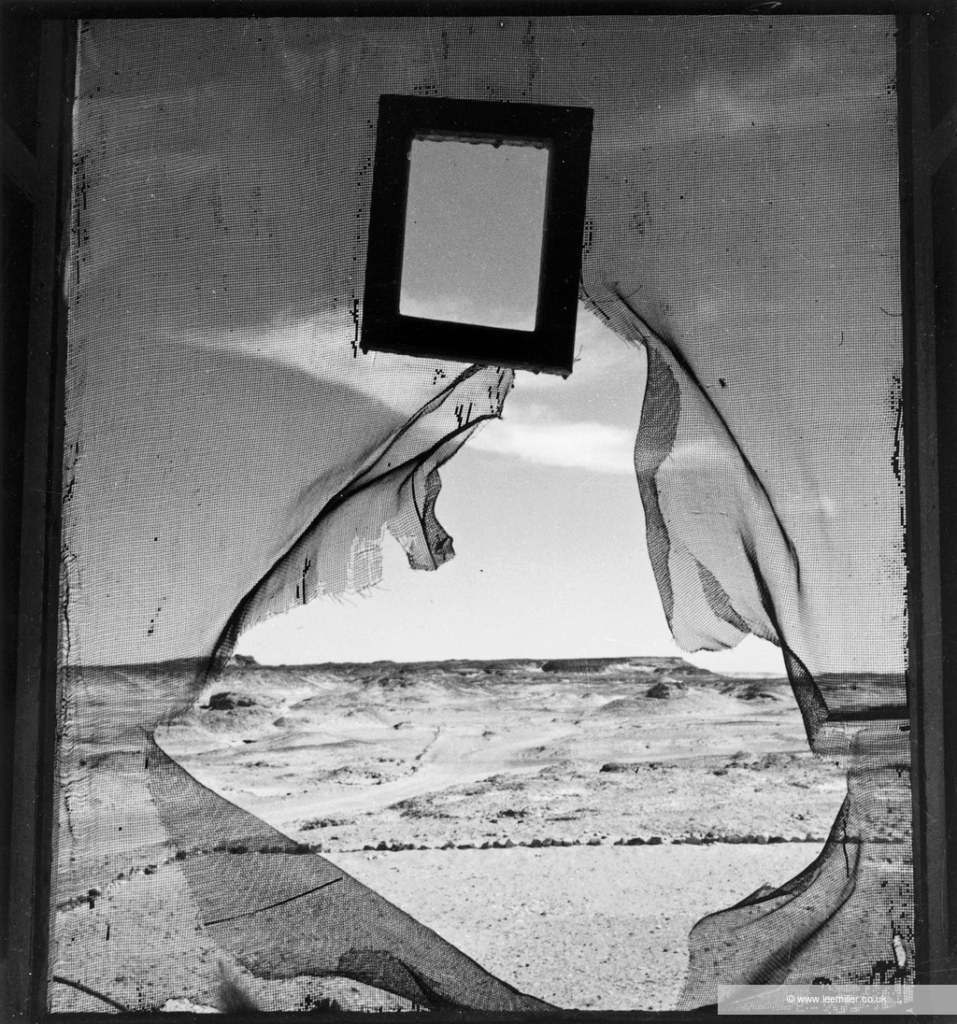
In 1934, she moved to Cairo, producing her celebrated photograph Portrait of Space (1937), a surreal depiction of the Siwa Oasis, alongside striking studies of Egypt and beyond. Many works from this period will be displayed publicly for the first time.
War and Witness
With the outbreak of WWII, Miller relocated to London, becoming a fashion photographer for British Vogue and later one of the few accredited female war correspondents. Her photographs captured Blitz-torn London, frontline scenes, and the devastation across liberated Europe.
Highlights include:
- You will not lunch in Charlotte Street today (1940)
- Fire Masks (1941)
- Harrowing documentation of post-liberation France, Germany, and Eastern Europe
- The iconic portraits of Miller and David E. Scherman in Hitler’s Munich apartment (1945), staged directly after photographing the Dachau concentration camp
Presented with Miller’s own essays published in Vogue, these works confront the brutal realities of war through a deeply personal lens.
Post-War Portraits and Legacy
After 1945, Miller continued to photograph her circle of artist friends, including Isamu Noguchi, Dorothea Tanning, Henry Moore, Jean Dubuffet, and others. A rare 1950 self-portrait, taken in Oskar Kokoschka’s London studio, closes the exhibition — Miller poised between two mirrors, framed by artworks, asserting herself as an artist among artists.
Exhibition Details
📍 Tate Britain, Millbank, London SW1P 4RG
📅 2 October 2025 – 15 February 2026
🕙 Open daily 10.00–18.00
🎟 Tickets: tate.org.uk | +44(0)20 7887 8888
Free for Tate Members – join at tate.org.uk/members
Follow @Tate #LeeMiller